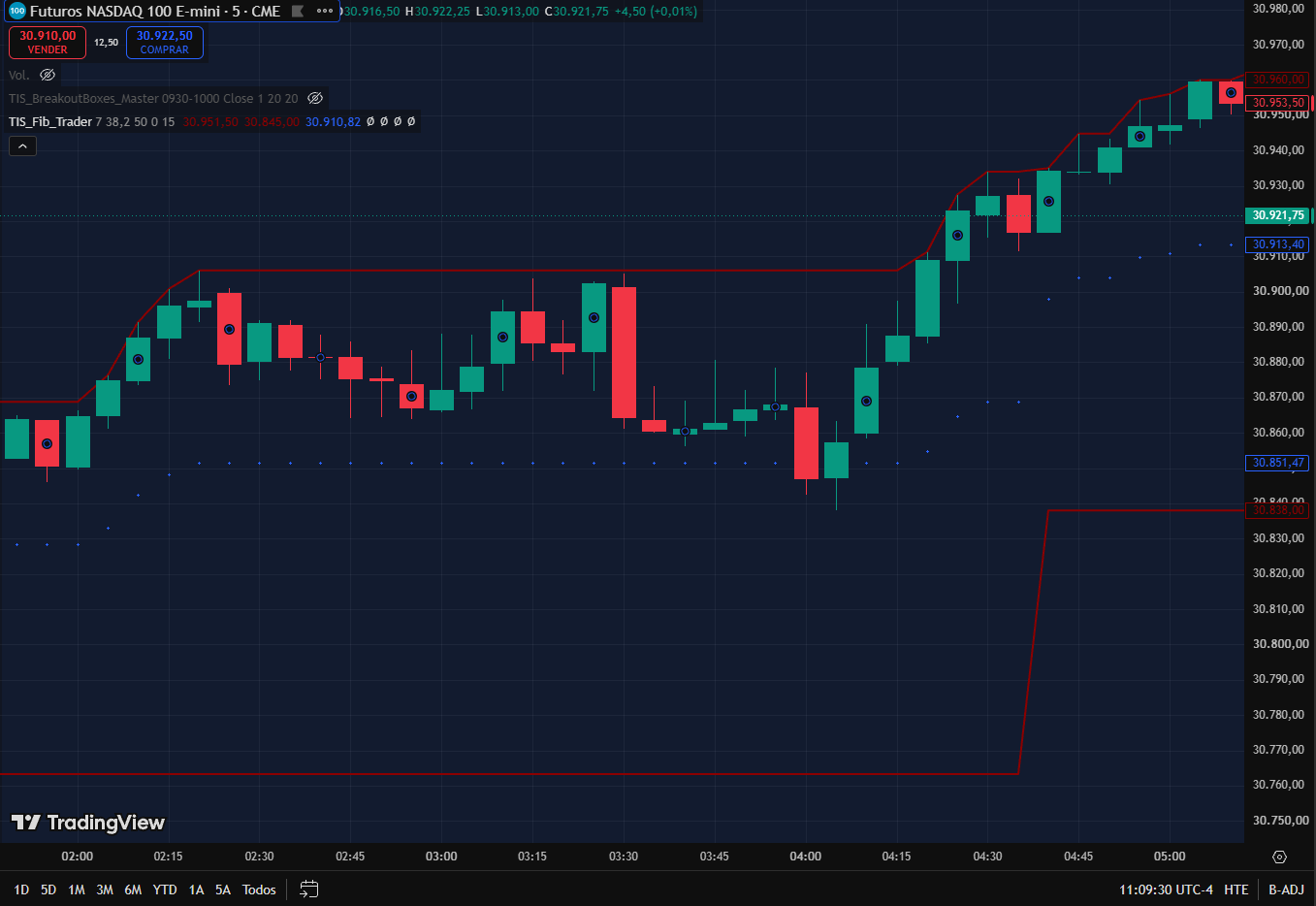
TIS_Fib_Trader for TradingView
This indicator is available by subscription only. Subscribe on our TradingView page →Este indicador está disponible solo por suscripción. Suscribite desde nuestra página de TradingView →
Indicador en Pine Script que mantiene un nivel de retroceso de Fibonacci anclado al tramo de swing en curso, extendiéndose con el movimiento para que nunca tenga que redibujar la herramienta. Las señales se disparan cuando el precio vuelve al nivel, filtradas por tamaño mínimo del tramo, confirmación opcional por cierre y un tope por tramo. Con alertas y compatible con TIS_Automator.
Pine Script indicator that keeps a Fibonacci retracement level anchored to the live swing leg, extending with the move so you never redraw the tool. Signals fire when price returns to the level, filtered by minimum leg size, optional close confirmation and a cap per leg. Alert-ready and compatible with TIS_Automator.
Descripción
TIS_Fib_Trader para TradingView mantiene un nivel de retroceso anclado al tramo en el que el mercado está realmente, y marca la barra en la que el precio vuelve a tocarlo. Sin arrastrar la herramienta fib, sin reanclar cada vez que el swing se extiende.
Cómo funciona
El indicador sigue el último swing alto y el último swing bajo confirmados, y toma la distancia entre los dos como el tramo actual. Con esos dos puntos calcula un único nivel de retroceso y lo dibuja sobre el gráfico. El nivel no es decorativo: es el precio que el setup está esperando.
Lo que lo mantiene honesto es que el tramo se mantiene solo. En el momento en que el precio se lleva puesto el máximo anterior, la dirección gira al alza y ese máximo deja de ser un punto fijo: pasa a ser un máximo corrido que se extiende con cada nuevo techo. El extremo de abajo queda anclado a la estructura. En tendencia bajista los roles se invierten. Así, mientras el movimiento sigue vivo, el nivel de retroceso se recalcula desde los extremos reales en lugar de hacerlo desde una foto que sacaste veinte barras atrás.
La señal dispara cuando el precio vuelve y alcanza el nivel después de haber estado lejos de él, y solo cuando el nivel mismo dejó de moverse, que es la forma que tiene el indicador de negarse a señalizar en medio de un cambio de estructura. Encima de eso tenés tres filtros bajo tu control: un tamaño mínimo de tramo en ticks para que un rango comprimido nunca genere un setup, la exigencia opcional de que la barra cierre del lado correcto del nivel, y un tope de cuántas señales puede darte un mismo tramo.
La dirección también se pinta en el fondo del gráfico, así sabés de un vistazo de qué lado está el tramo actual sin necesidad de leer los niveles.
Características principales
▸ Nivel de retroceso anclado automáticamente a la estructura de swings en vivo, sin colocación manual
▸ El extremo que lidera se extiende con el movimiento, así el nivel se sigue actualizando mientras el tramo corre
▸ Cualquier porcentaje de retroceso, no un conjunto fijo de ratios
▸ Sin señales mientras el nivel se sigue moviendo, lo que mantiene los setups fuera de los cambios de estructura
▸ Filtro de tamaño mínimo del tramo en ticks, para que un rango comprimido nunca produzca un setup
▸ Confirmación opcional por cierre del lado correcto del nivel
▸ Tope de cuántas señales puede producir un mismo tramo, con reinicio opcional cuando el nivel se mueve
▸ Fondo del gráfico pintado con el color de la dirección, con intensidad ajustable
▸ Los dos niveles de swing, el nivel de retroceso, las entradas y la dirección quedan expuestos como salidas para otros scripts
Parámetros
| Parámetro | Descripción |
|---|---|
| Pivot Strength | Barras a cada lado que definen un swing. Valores más altos siguen estructura más grande y cambian el nivel con menos frecuencia. |
| Fib Level (0~100) % | Porcentaje de retroceso medido hacia adentro del tramo. Acepta cualquier valor, no solo los ratios clásicos. |
| Min Fib Size (Ticks) | Distancia mínima entre los dos swings para que el setup se considere. Por debajo, el nivel queda neutral y no puede dispararse ninguna señal. |
| Close in Agreement | Exige que la barra cierre del lado correcto del nivel, no solo que lo toque. Menos señales y más tardías. |
| Max Consecutive Signals | Tope de cuántas señales se toman mientras corre el mismo tramo. 0 significa sin límite. |
| Reset Counter on Fib Change | Reinicia esa cuenta cada vez que el nivel se mueve, de modo que un tramo que se extiende se trate como una oportunidad nueva. |
| Color Up / Color Dn | Colores del nivel, las flechas y el fondo en cada dirección. |
| Paint Back | Pinta el fondo del gráfico con el color de la dirección actual. |
| Paint Back Opacity | Intensidad de ese fondo, en escala de 0 a 255. El default de 15 es deliberadamente muy tenue. |
| Paint Arrow Markers ? | Agrega una flecha junto a la vela, además del punto que marca el nivel de entrada. |
¿Para quién es?
Para el trader que ya opera retrocesos y está cansado de redibujar la herramienta cada vez que el swing se extiende, y de discutir consigo mismo dónde empezó realmente el tramo. El anclaje es mecánico, así que el nivel es el mismo cada vez que lo mirás y el mismo en todos los gráficos. Los filtros están para la parte que suele fallar: el tramo que era demasiado chico para importar, y la cuarta señal seguida contra un nivel que ya dejó de funcionar.
Listo para automatizar. TIS_Fib_Trader es totalmente compatible con nuestro sistema TIS_Automator: seleccionás las salidas de entrada larga y corta como fuentes de señal, definís target y stop, y las entradas en el retroceso se operan de punta a punta sin intervención manual.
TIS_Fib_Trader for TradingView keeps a retracement level anchored to the leg the market is actually in, and marks the bar price comes back to touch it. No dragging the fib tool, no re-anchoring every time the swing extends.
How It Works
The indicator tracks the last confirmed swing high and the last confirmed swing low and treats the distance between them as the current leg. From those two points it computes a single retracement level and draws it across the chart. The level is not decoration: it is the price the setup is waiting for.
What keeps it honest is that the leg maintains itself. The moment price takes out the previous high, the direction flips up and that high stops being a fixed swing point: it becomes a running maximum that extends with every new high. The low end stays anchored to the structure. In a downtrend the roles swap. So while a move is still going, the retracement level keeps recalculating from the real extremes instead of from a snapshot you took twenty bars ago.
A signal fires when price comes back and reaches the level after having been away from it, and only when the level itself has stopped moving, which is the indicator’s way of refusing to signal in the middle of a structure change. On top of that there are three filters you control: a minimum leg size in ticks so a compressed range never produces a setup, an optional requirement that the bar close back on the correct side of the level, and a cap on how many signals a single leg is allowed to give you.
The direction is also painted on the chart background, so you can tell at a glance which side the current leg is on without reading the levels at all.
Key Features
▸ Retracement level anchored automatically to the live swing structure, with no manual placement
▸ The leading extreme extends with the move, so the level keeps updating while the leg is still running
▸ Any retracement percentage you want, not a fixed set of ratios
▸ No signals while the level is still moving, which keeps setups out of structure changes
▸ Minimum leg size filter in ticks, so a compressed range never produces a setup
▸ Optional close confirmation on the right side of the level
▸ Cap on how many signals one leg can produce, with an optional reset when the level moves
▸ Chart background painted in the direction color, with adjustable strength
▸ Both swing levels, the retracement level, the entries and the direction exposed as outputs for other scripts
Parameters
| Parameter | Description |
|---|---|
| Pivot Strength | Bars on each side that define a swing point. Higher values track larger structure and change the level less often. |
| Fib Level (0~100) % | Retracement percentage measured back into the leg. Any value is accepted, not just the classic ratios. |
| Min Fib Size (Ticks) | Minimum distance between the two swing points for the setup to be considered at all. Below it the level turns neutral and no signal can fire. |
| Close in Agreement | Requires the bar to close back on the correct side of the level, not just to touch it. Fewer signals, later. |
| Max Consecutive Signals | Caps how many signals are taken while the same leg is running. 0 means no limit. |
| Reset Counter on Fib Change | Starts that count again every time the level itself moves, so an extending leg is treated as a fresh opportunity. |
| Color Up / Color Dn | Colors used for the level, the arrows and the background in each direction. |
| Paint Back | Paints the chart background in the color of the current direction. |
| Paint Back Opacity | Strength of that background, on a 0 to 255 scale. The default of 15 is deliberately very light. |
| Paint Arrow Markers ? | Adds an arrow next to the candle on top of the dot that marks the entry level. |
Who Is It For?
Traders who already buy retracements and are tired of redrawing the tool every time the swing extends, and of arguing with themselves about where the leg really started. The anchoring is mechanical, which means the level is the same every time you look at it and the same on every chart. The filters are there for the part that usually goes wrong: the leg that was too small to matter, and the fourth signal in a row into a level that has stopped working.
Automation ready. TIS_Fib_Trader is fully compatible with our TIS_Automator system: select the long and short entry outputs as signal sources, set your target and stop, and the retracement entries can be traded end to end without manual intervention.
Solo los clientes que hayan comprado este producto pueden dejar una opinión.


Opiniones
Aún no hay opiniones.