TIS_Reversal (Quantower)
$300.00
Detección de velas de reversión para Quantower. Agotamiento del estocástico más extremo de canal, con filtros opcionales y entrada RBO por ruptura.
Reversal bar detection for Quantower. Stochastic exhaustion plus channel extreme, with optional filters and RBO breakout entry.
Descripción
Indicador para Quantower
TIS_Reversal
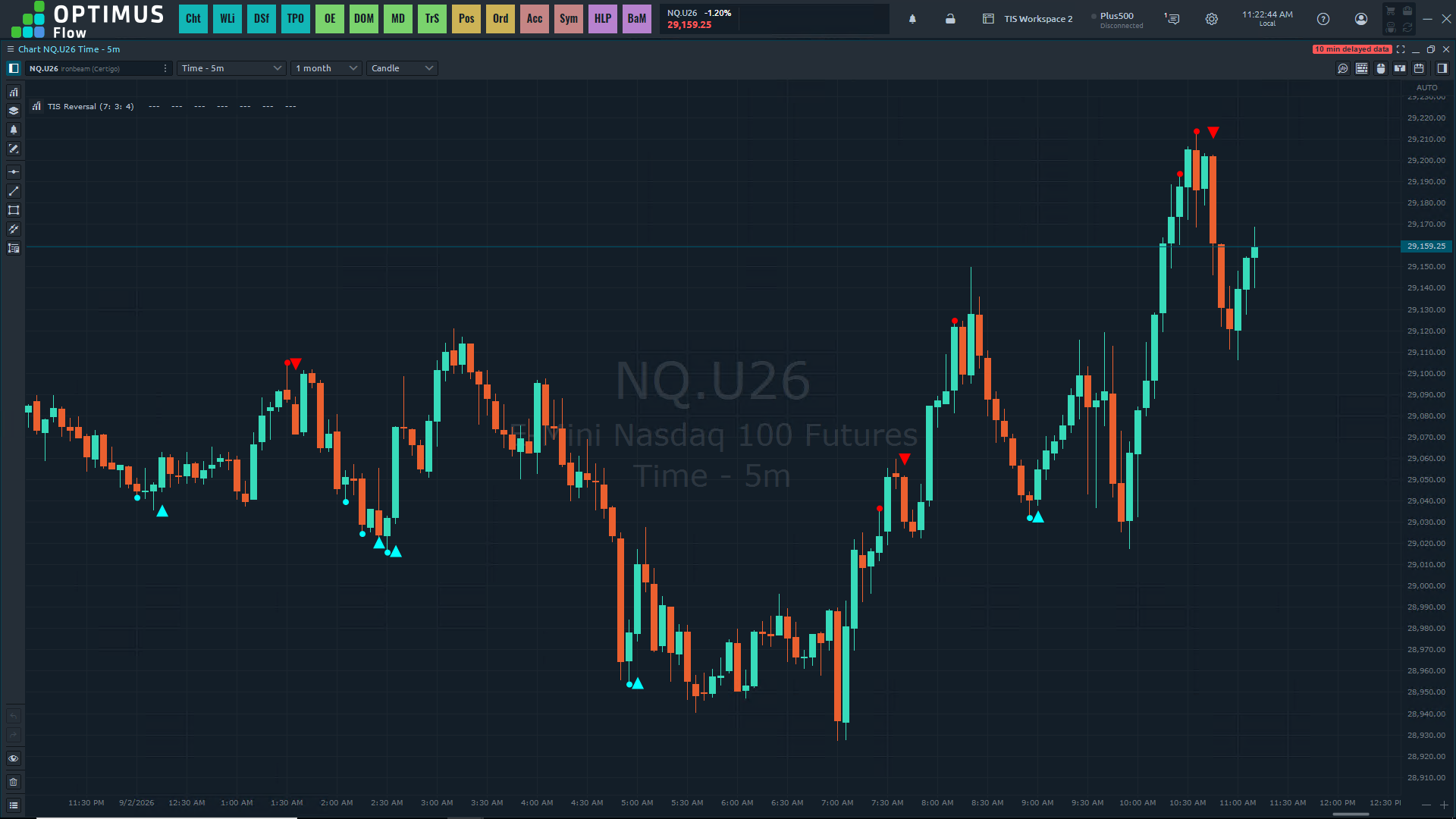
Detecta velas de reversión combinando el agotamiento del estocástico con la posición del precio en su canal reciente. Sobre esa señal base aplica hasta cuatro filtros opcionales, para que solo queden las reversiones que aparecen en el contexto correcto y no las que van contra un momentum fuerte.
Cómo funciona
La señal base necesita dos condiciones simultáneas: que el estocástico gire dentro de la zona de sobrecompra o sobreventa, y que el precio esté en un extremo de su canal de las últimas barras. La lógica de picos estocásticos detecta además los casos en que una sola vela toca la zona extrema, que es donde suele aparecer el agotamiento más temprano.
A partir de ahí, cada filtro que actives endurece el criterio: posición respecto de una EMA, pendiente de una EMA, pendiente de una regresión lineal con umbral propio, y tamaño mínimo de mecha para exigir un PinBar. Todos se desactivan poniendo su período en cero, así que podés arrancar con la señal cruda e ir sumando capas.
Las señales se evalúan sobre velas cerradas. Una vez que la vela cierra y la señal aparece, no se retracta.
El módulo RBO (Reversal BreakOut) suma una entrada alternativa: en vez de entrar en la vela de señal, dibuja un nivel de entrada por ruptura con vida útil en barras. Si el precio no lo alcanza dentro de ese plazo, el setup se descarta.
Características principales
▪ Señal de reversión por giro del estocástico en zona extrema más posición en el canal
▪ Lógica de picos estocásticos para detectar agotamientos tempranos
▪ Filtro de EMA por posición y por pendiente, cada uno desactivable
▪ Filtro de pendiente de regresión lineal con umbral y suavizado propios
▪ Filtro de PinBar con tamaño de mecha configurable en ticks
▪ Módulo RBO con nivel de entrada por ruptura y vida útil en barras
▪ Señales sobre velas cerradas, sin marcas que aparecen y desaparecen
▪ Desarrollado para Quantower, no adaptado desde una solución genérica
Parámetros
| Parámetro | Descripción |
|---|---|
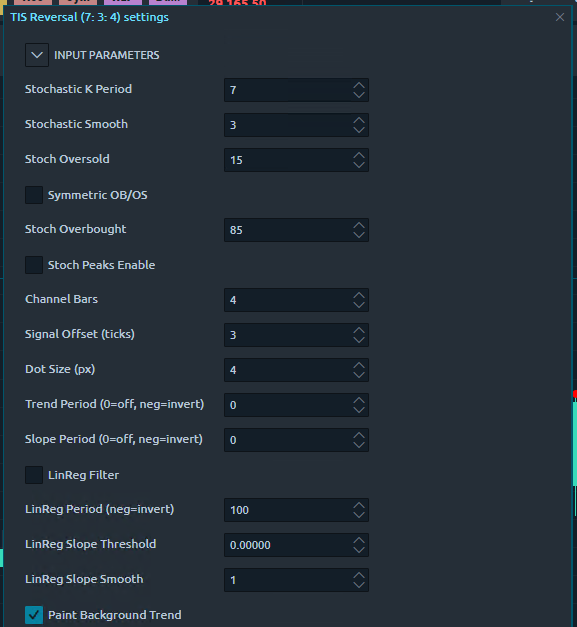
| Stochastic K Period / Smooth | Período y suavizado del estocástico usado para detectar el giro. |
| Stoch Overbought / Oversold | Niveles que definen las zonas extremas donde se busca la reversión. |
| Symmetric OB/OS | Espeja automáticamente el nivel de sobreventa respecto del de sobrecompra. |
| Stoch Peaks Enable | Activa la detección de picos donde una sola vela toca la zona extrema. |
| Channel Bars | Cantidad de barras del canal de precio usado como condición de extremo. |
| Trend Period | Filtro de posición respecto de una EMA. 0 lo desactiva; un valor negativo invierte la condición. |
| Slope Period | Filtro de pendiente de una EMA. 0 lo desactiva; un valor negativo invierte la condición. |
| LinReg Filter / Period | Activa el filtro de regresión lineal y define su período. Un período negativo opera en contra de la pendiente. |
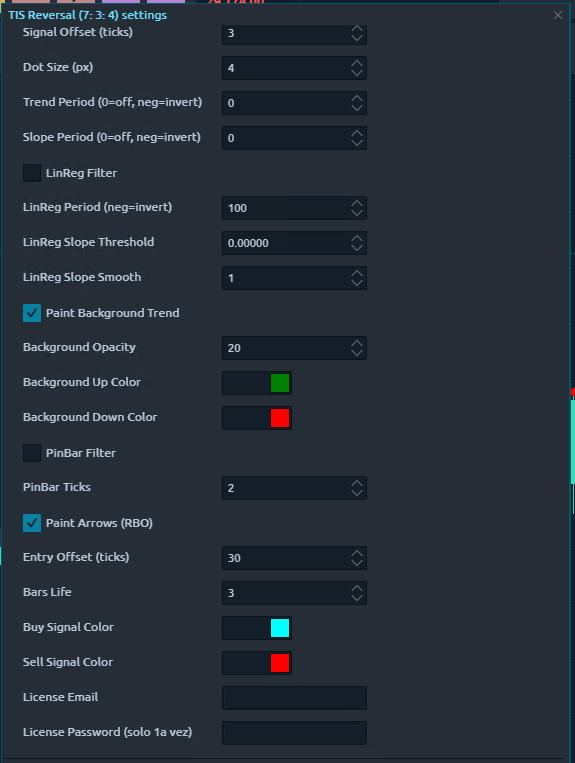
| LinReg Slope Threshold / Smooth | Pendiente mínima requerida para habilitar la operación, y su suavizado. |
| Paint Background Trend | Pinta el fondo del gráfico según la tendencia de la regresión, con colores y opacidad configurables. |
| PinBar Filter / PinBar Ticks | Exige que la vela de señal sea un PinBar, con tamaño mínimo de mecha en ticks. |
| Entry Offset / Bars Life | Distancia del nivel de entrada RBO respecto de la vela de señal, y cuántas barras sigue vigente. |
| Paint Arrows / Paint RBO Entry Price | Dibuja las flechas de disparo y la línea horizontal del precio de entrada. |
¿Para quién es?
TIS_Reversal es para el trader que opera agotamientos y quiere control fino sobre cuándo aceptar una reversión y cuándo descartarla. Cada filtro es independiente y se apaga con un cero, así que sirve igual para quien quiere la señal cruda y para quien arma un criterio estricto de varias capas antes de dar una entrada por válida.
La plataforma va por separado
The Indicator Store provee el indicador. La licencia de Quantower, el broker, los datos de mercado y la conexión de ejecución se contratan aparte con el proveedor que elijas.
Compatible con Quantower. Incluye guía de instalación paso a paso y soporte de The Indicator Store.
Quantower indicator
TIS_Reversal
Detects reversal bars by combining stochastic exhaustion with the position of price inside its recent channel. On top of that base signal it applies up to four optional filters, so only the reversals that show up in the right context survive, not the ones fighting strong momentum.
How It Works
The base signal needs two conditions at once: the stochastic turning inside the overbought or oversold zone, and price sitting at an extreme of its channel over the last bars. The stochastic peaks logic additionally catches the cases where a single bar touches the extreme zone, which is usually where exhaustion shows up earliest.
From there, every filter you enable tightens the criterion: position relative to an EMA, EMA slope, linear regression slope with its own threshold, and minimum wick size to require a PinBar. All of them switch off by setting their period to zero, so you can start with the raw signal and add layers from there.
Signals are evaluated on closed bars. Once the bar closes and the signal prints, it does not take itself back.
The RBO module (Reversal BreakOut) adds an alternate entry: instead of entering on the signal bar, it plots a breakout entry level with a defined lifespan in bars. If price does not reach it within that window, the setup is discarded.
Key Features
▪ Reversal signal from a stochastic turn in the extreme zone plus channel position
▪ Stochastic peaks logic for early exhaustion detection
▪ EMA filter by position and by slope, each one independently disabled
▪ Linear regression slope filter with its own threshold and smoothing
▪ PinBar filter with wick size configurable in ticks
▪ RBO module with breakout entry level and lifespan in bars
▪ Signals on closed bars, no marks that appear and vanish
▪ Developed for Quantower, not adapted from a generic solution
Parameters
| Parameter | Description |
|---|---|
| Stochastic K Period / Smooth | Period and smoothing of the stochastic used to detect the turn. |
| Stoch Overbought / Oversold | Levels that define the extreme zones where reversals are looked for. |
| Symmetric OB/OS | Automatically mirrors the oversold level from the overbought one. |
| Stoch Peaks Enable | Enables detection of peaks where a single bar touches the extreme zone. |
| Channel Bars | Number of bars in the price channel used as the extreme condition. |
| Trend Period | EMA position filter. 0 disables it; a negative value inverts the condition. |
| Slope Period | EMA slope filter. 0 disables it; a negative value inverts the condition. |
| LinReg Filter / Period | Enables the linear regression filter and sets its period. A negative period trades against the slope. |
| LinReg Slope Threshold / Smooth | Minimum slope required to allow a trade, and its smoothing. |
| Paint Background Trend | Shades the chart background by regression trend, with configurable colors and opacity. |
| PinBar Filter / PinBar Ticks | Requires the signal bar to be a PinBar, with a minimum wick size in ticks. |
| Entry Offset / Bars Life | Distance of the RBO entry level from the signal bar, and how many bars it stays active. |
| Paint Arrows / Paint RBO Entry Price | Draws the trigger arrows and the horizontal entry price line. |
Who Is It For?
TIS_Reversal is for the trader who trades exhaustion and wants fine control over when to accept a reversal and when to discard it. Every filter is independent and switches off with a zero, so it works both for someone who wants the raw signal and for someone who builds a strict multi-layer criterion before calling an entry valid.
The platform is separate
The Indicator Store provides the indicator. Quantower licensing, brokerage, market data and the execution connection are contracted separately with the provider you choose.
Compatible with Quantower. Includes a step-by-step installation guide and support from The Indicator Store.
Solo los clientes que hayan comprado este producto pueden dejar una opinión.
Productos relacionados
-

-
Oferta
¡Oferta!
TIS_Reversal + Template
El precio original era: $450.00.$395.00El precio actual es: $395.00. -
-
Opiniones
Aún no hay opiniones.